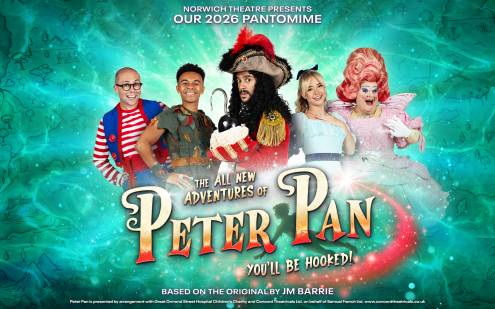
As Norwich Pride is this weekend, it is the perfect time to reflect on the milestones that paved the way for the visibility we see today. Andrew Lynford, our very own pantomime Director, knows a little about making history. Before he steered our pantomime ship, he was part of an LGBTQIA+ moment that helped begin visibility on TV when he played a leading role in EastEnders.
Before he made broadcasting history, Andrew’s journey into the spotlight began much closer to the stage.
Growing up in Hornchurch, Essex, Andrew was hooked on theatre after a childhood trip to his local pantomime at the Queen’s Theatre. By age 12, he had joined their Youth Theatre and was sharing the stage with professional actors.
After training at the Mountview Theatre School, and spending several years with near misses for roles in West End musicals, he cut his teeth in regional theatre seasons. He also became a presenter for the BBC’s Playdays. “I was on the ‘Tent Stop’ on Fridays, the dressing-up and storytelling day,” Andrew smiles. “I was good friends with the Why Bird and Poppy the Cat.”


After years of mailing his headshots to the BBC casting office, Andrew finally landed an audition for Simon Raymond, Tiffany’s brother in EastEnders. The interview lasted just 15 minutes. “We just sat and chatted. They knew he was going to be a gay character and that there was potential controversy,” Andrew recalls. Before he even made it home, his agent called with an offer for the job. Initially signed for just three months, the scripts kept arriving in the post for a whirlwind four-year run that would captivate 20 million viewers per episode.
In the height of summer in 1996, during a special location shoot on Blackpool Pier, Andrew and co-star Mark Homer (Tony Hills) filmed one of TV’s very first prolonged gay kisses.
“We went up to Blackpool, and we were just mobbed everywhere we went on the streets,” Andrew recalls. “We had security and it was just like being a movie star. It really was just bonkers, the programme was so popular at that time.”
But the real whirlwind started when the episode was set to air, as the BBC edited the seven-second kiss down at the last minute. The ensuing press frenzy was immediate. “Suddenly, we were called up to the BBC press office, and we made a statement saying that we were disappointed with the edit.” According to Andrew, the 90s tabloids ran the headlines ‘Get this filth off our screens’, and the Church of England said the BBC was trying to corrupt young people. “The BBC even told me I should stay home because I might get beaten up in the street. That’s how different the time was.”

At just 23 years old, Andrew was navigating that level of scrutiny in an industry that was far from welcoming to openly queer performers.
“I never came out as a gay actor the whole time, because in those days, if you had done that, you would never have worked,” Andrew shares candidly. “I wish in a way that I’d been probably a little bit braver… but I was 23, and I wanted a career.”
Despite the backlash, the show stuck by the storyline. Tony and Simon stayed together, tackling real, grounded social commentaries. They faced homophobia, gay-bashing, workplace discrimination, and the struggle for access to a child within a gay family structure.

Decades later, the impact of the relationship continues to ripple out. “You still get people talking to you about something that was so important. Over the years, I’ve realised how affectionate people were about this moment.”
Today, Andrew’s creative life has come full circle as he returns to direct his second pantomime season at Norwich Theatre this Christmas. As a successful writer, director, and casting director, he has witnessed a massive, positive shift in the industry. “I’m really excited by the visibility and the freedom within the industry to allow actors of all backgrounds to have a much louder, clearer voice,” he says.
As we celebrate Pride, Andrew emphasises that progress should not mean forgetting the history that built it.
“You always have to know the history of the struggle. It is really important that everyone remembers and stays grounded in how far we have come, because then we can truly celebrate.”
When asked what advice he would pass on to the next generation of LGBTQ+ creatives entering the industry today, his answer is simple and clear:
“Be your authentic self. Celebrate who you are, but put in the hard work.”