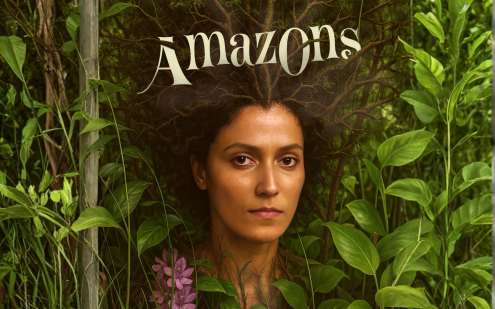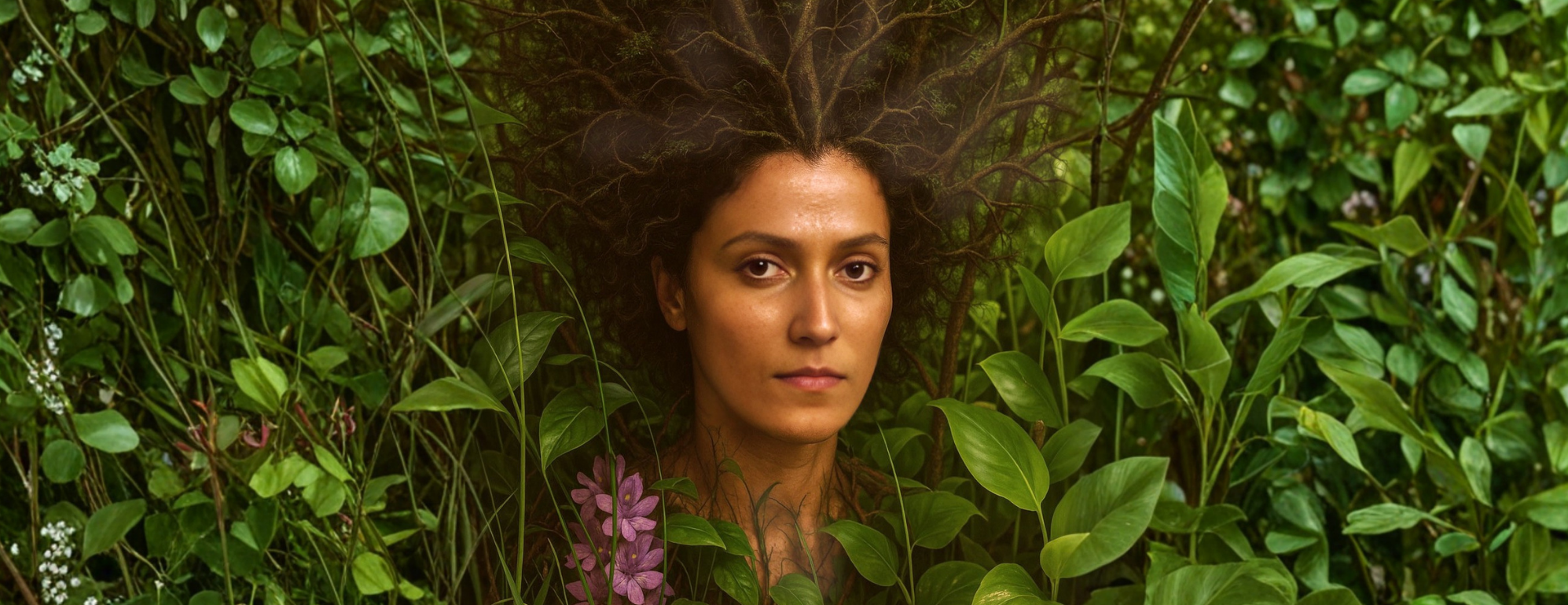
We spoke with theatre-maker Gaël Le Cornec ahead of her upcoming show Norwich Theatre Show Amazons (1 Aug). We chatted with Gaël about this deeply personal show, reconstructing her family tree, bringing the rainforest to the stage, and her creative process.

Tell us a little bit about you.
I am a biologist-turned-actress, theatre-maker, and filmmaker. I was born in Belém, in the Brazilian Amazon, and migrated to the UK to complete a Master’s degree—and somehow, I stayed! I work in theatre, TV and film. I’m also an acting teacher –I have worked at Regent’s University London, Rose Bruford College, and the University of Essex.
Things I love: theatre, walks in nature, and açaí berries (did you know they are from the Amazon?)
Tell us about the show.
Amazons is about the silencing of women’s voices and how we, as women, still censor ourselves to fit in, due to a lack of self-belief or because of the patriarchal structures we live in. It is also about women’s relationship to nature and memory: what we are told to remember, what we choose to remember, and how sometimes, because of historical erasure, we need to construct our own memories.
My starting point was investigating the life of my Brazilian grandmother, an Amazonian woman who carried a deep knowledge of herbal medicine. She migrated from the forest to the city and, later in life, lost both her memory and her ability to speak. I realised I knew nothing of my lineage before her. I asked my family and searched local archives, but found very little information.
So, what do you do when there is a lack of memory? You imagine.
I imagined how the forest knowledge she carried was passed down through generations over 500 years, despite colonisation threatening to erase it.
You will also see me on stage sharing my childhood memories, family photos, video archives, and Amazonian a cappella songs. All with a good dose of humour!
Describe the show in three words.
I would like to believe it is enlightening, powerful, and moving. Or maybe I am just repeating what others have said!
How do you hope the audience will feel after seeing the show?
Inspired, more curious, touched. I hope it will also enhance their sense of connection to this remarkable forest and its people on the other side of the Atlantic.


Why is this important to tell now?
A show that spotlights the contributions of women is essential in a world where gender equality has still not been achieved. Today, it is particularly important to highlight the stories of women from historically marginalised communities.
Additionally, while most people have heard of the Amazon, many do not know about its crucial role in regulating the planet’s climate—and, of course, the guardians of the forest are essential to that. Colonisation led to rapid deforestation and climate deregulation, the consequences of which we are all feeling during the summer months.
How do you use different media to tell the story?
Because of the show’s setup and staging (no spoilers for now!), the protagonist sometimes manipulates a live camera. We also use 3D spatial sound, video projections, and AI makes a brief appearance. My view on technology is simple: if it helps the audience understand or connect to the story, use it.
What made you want to create the show?
Ten years ago, I took a DNA test that confirmed I have Black and Native American descent. Later, during the pandemic lockdown, I embarked on an investigation into my mother’s lineage and realised there were no archives available beyond my grandmother.
I then looked into the historical archives of the Amazon region. I discovered that my hometown, Belém, has served as a port and entry point into the Amazon forest for thousands of years. It was originally called, in the indigenous Tupi language, “Mairi”, which translates to “place of passage”. I kept digging into the history of the Amazon, my family, and myself; I’m still digging.

Can you tell us about the creative process?
When I write a play, I write in the script both the content and the form simultaneously. I usually have an idea of how it will take shape in the performance space. I often write visual images, stage directions, and design sketches directly into the script. This is because I like to think early on about how the audience will experience the piece both visually and aurally. Then I keep rewriting after every show.
I regularly collaborate with directors who are happy with this process and who act as an “outside eye”—taking on the role of the audience and giving feedback on what they think is or isn’t working. For Amazons, I am working with my long-term collaborator Ben Samuels from Limbik Theatre, who is incredible. Ben is assisted by Andrés Maerker, a brilliant young Latin American theatre-maker. They have been my rock, and Amazons simply would not exist without them.
Why should people come see the show?
Amazons is a heartfelt story shared through a mixed-media performance. It is fun, informative, moving, and an act of resistance against silencing and erasure.
You can catch Amazons at Norwich Theatre Stage Two on 1 Aug. For more information or to book, visit norwichtheatre.org or call the Box Office on 01603 630 000.