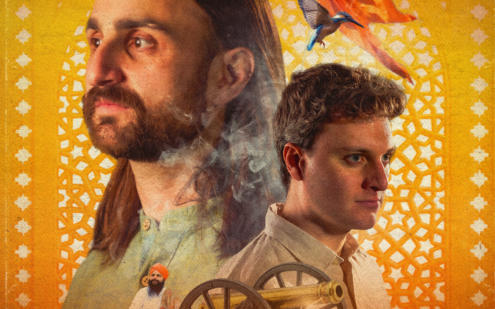
What if the history you were taught was only half the story? Ahead of Kanpur 1857 arriving at Norwich Theatre Playhouse on 30 June, we caught up with award-winning theatremaker Niall Moorjani.
Their gripping new two-man play places a British Officer and an Indian rebel, strapped to a cannon, in a high-stakes interrogation. We chatted with Niall about reclamation, balancing sharp humour with historical trauma, and the pre-show ritual that gets them into character.
Tell us a little bit about yourself.
I am a theatre maker, writer and storyteller whose work often centres on the historical and mythical. I have performed all over the world and have won major awards, including a Fringe First. I am embarrassingly invested in cricket, and, for a theatremaker, am remarkably bad at singing and dancing.
Can you tell us a bit about the show?
Set in the aftermath of the Indian Uprising of 1857. It is a two-hander which sees a British Officer interrogating an Indian rebel over the crimes of Kanpur, all while the rebel is strapped to a cannon. It is complex, nuanced and darkly funny.

Why was this story important to tell?
It is a massive story from the Indian uprising, which is almost exclusively told from a British perspective. In a time of the far right and white supremacists seizing control over national narratives, it feels more important than ever to tell stories of resistance and uprising in the face of occupation.
Can you describe the show in 3 words?
Funny, philosophical, explosive.
What would you hope to leave the audience feeling
With a sense of understanding of the nuance of uprisings and the realities of British Rule in India.

You’ve created a darkly comic satire about a deeply traumatic historical event. How do you use humour as a tool without undermining the real tragedy of history?
It is a tricky balance, but ultimately, I think that the key lies in mocking the mindsets and ideologies that underpinned colonial rule. When you dig into them, they are laughably absurd, so the key is to mock those, whilst holding space and reverence for the gravity of what came to pass in that time.
As a two-man team writing, directing, and starring in this together, what does your creative process look like?
So I (Niall) wrote the play, and then we co-directed it. But Jonathan was heavily involved from the very early stages of development and played an absolutely key dramaturgical role. It was very organic and practical. I would write, we would play with what I had written, have some thoughts, I would write some more, we would stage some more and eventually the piece took shape as it is. We were surprised by how similar our processes are; both of us have a firm belief that each project requires a different approach rather than rigid rules, and I think that allowed us to work very easily towards the final version of the show. We were always clear that we wanted the story to speak for itself, and so the staging needed to be stripped back and simple. Often, we would give each other notes mid-scene, and it was a really fun way of working the piece into shape as actors and directors. From time to time, we had outside eyes in, and that was incredibly valuable as well. We still tinker with it every show. Just the other day, Jonathan told me to try the ending with a slightly different intention, and we found it had wonderful consequences. So the show is still a little different every day.
What is your pre-show ritual?
Jonathan starts in the audience, so we split up before Sodhi (the musician), and I head backstage. We always tell each other to have a great show, then say “F-you” as a way of getting into character a little. Then Sodhi and I stretch backstage, talk nonsense until it’s go time. During the Edinburgh Fringe, Sodhi developed a superstitious habit of adjusting a backstage microphone stand, but he hasn’t found a replacement for that just yet. Maybe he will on this tour.
If you could force one historical figure to sit in the audience and watch this show, who would it be?
The obvious answer is one of the British officers or commanders from the Uprising, but let’s face it, they did what they did believing it was fine because of the lesser human nature of Indians. So I actually think I would like for Hussani (a figure from the show and the time) to see it. We know so little about her, and she was blamed for so much. I choose to believe she was nowhere near as evil as the British historians made her out to be, and hope that she would like to see herself reflected in the light I chose.
Kanpur 1857 is at Norwich Theatre Playhouse on 30 Jun. For more information or to book, visit norwichtheatre.org or call the Box Office on 01603 630 000.