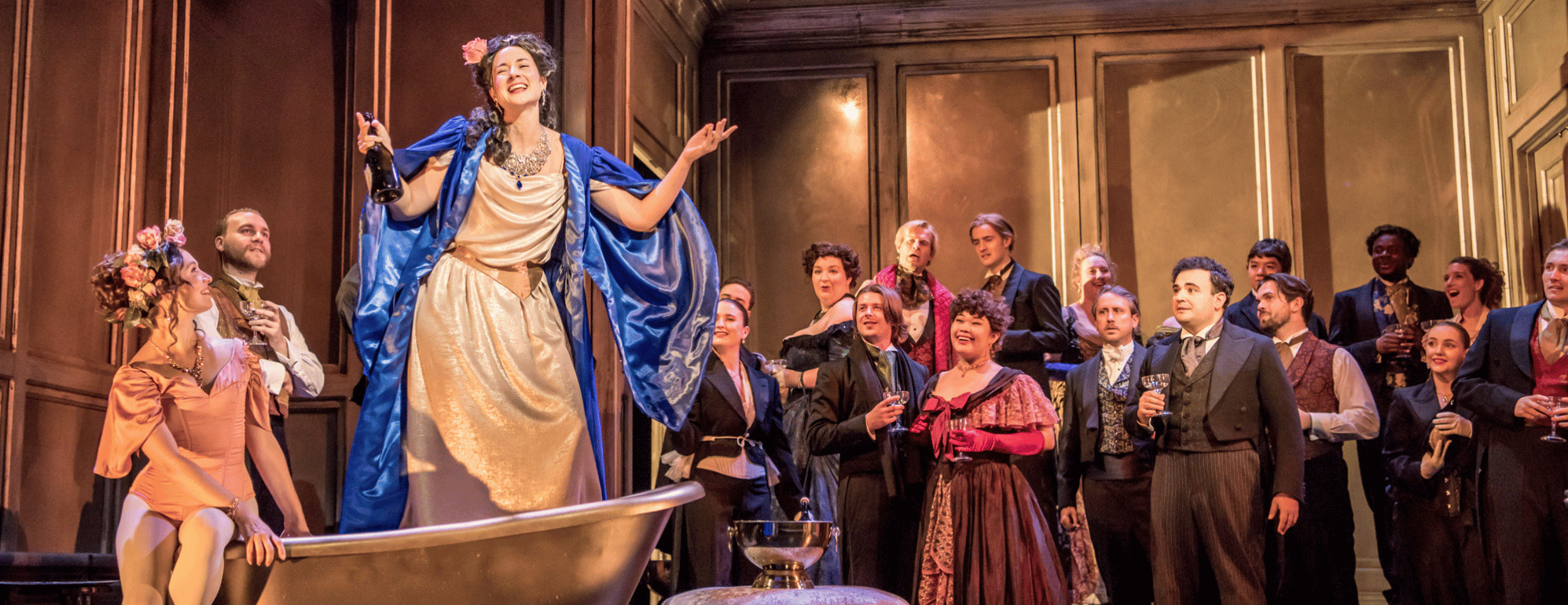
A story of love and sacrifice
Set in Paris, Violetta Valéry is a glamorous courtesan at the centre of high society, but she’s also seriously ill. Despite her wealth and popularity, she longs for something more meaningful than the lavish parties and superficial relationships that define her life.
When she falls in love with the sincere young Alfredo Germont, Violetta dares to imagine a different future. The pair leave Paris to begin a new life together, but their happiness is short-lived. Alfredo’s father, Giorgio Germont, persuades Violetta to end the relationship, believing that her reputation will destroy his family’s social standing.
Heartbroken, Violetta sacrifices her own happiness for the people she loves. Alfredo, unaware of the truth, publicly humiliates her before discovering the devastating reason for her actions. By the time the lovers are reunited, Violetta’s tuberculosis has taken its toll, leading to one of opera’s most moving finales.


You’ve probably heard the music before
Born in Italy, Giuseppe Verdi (1813–1901) composed 26 different operas during his lifetime, including Aida and Rigoletto.
His score for La traviata is packed with some of opera’s most recognisable melodies, none more so than the famous drinking song, the “Brindisi” in Act I, as Alfredo makes a toast singing “Libiamo ne’ lieti calici” (which roughly translates to ‘let’s get drunk’).
Violetta’s spectacular aria “Sempre libera” is another highlight. A dazzling display of fast vocal runs, trills, and jumps (or ‘vocal fireworks’), it captures her determination to remain free, even as she begins to fall in love.
As the story unfolds, the music shifts effortlessly between glittering party scenes and deeply intimate moments, culminating in a heartbreaking final act that showcases Verdi’s gift for emotional storytelling.
There was controversy when it first opened
Verdi based La traviata on a play adaptation of Alexandere Dumas fils’ scandalous 1848 novel The Lady of the Camellias. The story itself was inspired by the real-life Parisian courtesan Marie Duplessis, whose short but extraordinary life (also succumbing to tuberculosis) fascinated nineteenth-century society.
In his work, Verdi always sought strong subjects featuring relatable human characters, often breaking with convention. Yet at its Venice premiere in 1853, audience members mocked the casting of acclaimed soprano Fanny Salvini-Donatelli in the role of Violetta, calling it unrealistic for a desired courtesan.
Meanwhile, critics and censors were perhaps more concerned about the opera’s modern setting with a seriously ill courtesan as the central heroine – in a world that depended upon women like Violetta while simultaneously condemning them, a bit too close to the bone perhaps?
After some revisions, and with a new Violetta at the helm, the opera’s popularity meant that it quickly spread to cities like Vienna, London, Paris and New York.

Get ready for a considered take on this classic story
Rather than simply re-creating the classic “glitz” of Belle Époque Paris, this production explores the contrast between public glamour and private reality.
Designer Elliott Squire has created a world that reflects both the beauty and fragility at the heart of the story by embracing period’s jewel-box imagery. In his words, the box functions almost like a gilded cage, opening and closing to reveal the action throughout the opera .
Meanwhile, from a full orchestra pit, the Buxton International Festival Orchestra will accompany the action on stage, with the opera being sung in Italian with English surtitles.
La traviata is Norwich Theatre’s latest co-production with Buxton International Festival, following previous titles including The Land of Might-Have-Been, La Tragédie de Carmen and last year’s double bill of Trouble in Tahiti and Francis Poulenc’s La Voix Humaine.
Did you know?
- La traviata means “The Fallen Woman”
- The story of La traviata has inspired countless films, books and stage productions. The plot parallels with award-winning films such as Moulin Rouge!, Pretty Woman, and, more recently, Sean Baker’s Anora, are unmistakable when it comes to this deeply human story.
- “Sempre libera” was drag queen Felicia’s anthem in Adventures of Priscilla, Queen of the Desert as she speeds over the sand on top of that bus! It was also used as the soundtrack to car adverts for Nissan.
Audiences continue to love it
Few operas combine unforgettable music with such an emotionally direct story. La traviata explores love, loss, sacrifice and the desire to live life on your own terms—universal themes that continue to resonate across generations.
Whether you’re a lifelong opera fan or attending your very first performance, La traviata offers an unforgettable introduction to one of the greatest works ever written for the stage.